In September 2019, I created a GitHub repository called BarterSystem.
There was no grand launch. There was barely a project. The repository contained a two-line README describing a private proof of concept and, later, an empty test file. Then it sat untouched for seven years.
But the thought behind it stayed with me.
I had a gut feeling that some form of direct exchange might become relevant again—not because humanity would forget money, but because technology might eventually make it easier to discover what people can offer one another.
Today, with anxiety around AI and AGI growing, I find myself returning to that old repository.
The fear beneath the AI conversation
Some discussion about AI is exaggerated. Fear spreads faster than careful analysis, and dramatic predictions get more attention than uncertainty.
But beneath the fear-mongering are legitimate questions.
What happens if a small number of people and companies capture most of AI's productivity gains? What happens to workers whose skills become easier to automate? What if those who know how to use AI become dramatically more productive while others struggle to enter the new economy? What happens when the gap between owners and workers, rich and poor, or highly connected and isolated communities grows wider?
The outcome is not predetermined. AI could raise productivity and incomes broadly. It could help less-experienced workers acquire capabilities faster. It could also increase labor or wealth inequality when its benefits flow disproportionately to highly paid workers and owners of capital. Serious economic research describes several possible futures, not one inevitable result.
That uncertainty is exactly why it is worth thinking about alternative ways people might exchange value.
Money is not disappearing
I want to be careful here. I am not predicting that currency will become useless or that society will return to trading sacks of rice for shoes.
Money solved important problems. It gives us a common unit for comparing value, a store of value across time, and a medium of exchange that allows specialization. Without it, barter traditionally requires what economists call a double coincidence of wants: I must have something you want at the same moment that you have something I want.
If I can repair computers and need dental care, I have to find a dentist who happens to need computer repair. That search is inefficient. Money lets me repair a computer for one person, receive a broadly accepted medium, and use it to pay an entirely different person.
AI does not eliminate the usefulness of money.
But it may change the difficulty of finding the right exchange.
AI can see exchanges people cannot
A conventional marketplace asks people to fit what they offer into categories and keywords. A more capable matching system could understand needs described in ordinary language, account for location and timing, and identify relationships that are not obvious.
Consider three people:
A designer needs help preparing taxes.
An accountant needs a bicycle repaired.
A mechanic needs a simple website.
No pair forms a direct barter match. But together they form a loop.
A graph-based system could discover that loop. A language model could recognize that “help positioning my small business online” may match someone offering web design, even if neither person used the same words. An assistant could help clarify scope, availability, location, and expectations before anyone agrees.
This begins to look less like primitive barter and more like an intelligent coordination network.
offers + needs + constraints + trust
                  ↓
        explainable exchange paths
The critical word is explainable. AI should be able to say why it suggested an exchange and which constraints may conflict. It should not quietly assign a score to a person's worth or make binding decisions on anyone's behalf.
Value is larger than price
Part of what attracts me to this idea is that useful value often exists outside a person's bank balance.
Someone may not have spare cash but may have time, knowledge, tools, an unused room, language ability, transportation, mentoring experience, or a skill that another person genuinely needs. A retired professional may have expertise but no interest in returning to conventional employment. A student may be able to create a website in exchange for career guidance. A small business might trade unused capacity with another local business.
A good system could make these capabilities easier to see without pretending they are all interchangeable.
That distinction matters. Not every exchange is fair merely because both sides contain one item. An hour of work is not automatically equal to another hour in every context. Urgency, risk, equipment, training, physical effort, scarcity, and responsibility all matter. An algorithm may help participants reason about an exchange, but it cannot produce an objective price for human contribution.
The goal should be informed agreement, not automated valuation.
Resilience—or a shadow economy of desperation?
A barter network can be described as empowering: people turn underused capabilities into mutual value, communities become more resilient, and participation is possible even when cash is tight.
It can also become exploitative.
If people use barter because they have been excluded from stable work, the system could normalize unpaid labor instead of improving their position. Powerful participants might pressure vulnerable people into unequal exchanges. Reputation systems can reproduce discrimination, punish newcomers, or become permanent social scores. In-person exchanges create safety risks. AI matching can leak private information or amplify patterns of bias. Fraud, non-performance, illegal listings, harassment, and retaliation do not disappear because no money changed hands.
There are legal and tax realities too. In the United States, the fair market value of goods or services received through barter generally must be included in income. Calling something an exchange does not place it outside society's existing obligations.
It should be: Can people understand the match, refuse it freely, protect their privacy, resolve a problem, and leave the exchange better off?
If those questions are postponed until after growth, the project will have misunderstood its purpose.
Reopening the repository
I recently reopened that old 2019 repository. I could have deleted the almost-empty history and launched something polished. I chose not to.
The timestamp matters to me. It is a small record of a thought that arrived before I knew how—or whether—to build it.
The repository is now public, but it is still intentionally early. I have added a clearer vision, an initial roadmap, contribution guidance, product principles, safety boundaries, and a set of starter issues. There is no production application and no predetermined technology stack.
That is deliberate. Before choosing a framework, I want to understand the exchange problem:
- Which real situations would benefit from barter-like exchange?
- When is direct matching enough, and when do we need multi-party loops?
- How can recommendations remain explainable and voluntary?
- What information is too sensitive to give an AI model?
- How should trust, blocking, reporting, disputes, and incomplete exchanges work?
- What would prove that the idea is useful—or that it should stop?
An invitation to think and build
I am opening BarterSystem to contributors.
You do not have to be a software engineer. This idea needs designers, economists, community organizers, trust-and-safety practitioners, researchers, and people who have participated in mutual-aid, time-banking, cooperative, or informal exchange networks. It also needs skeptics who can explain why the premise is wrong.
The open issues include documenting real exchange scenarios, defining a small domain model, comparing matching approaches, creating a threat model, and building an explainable prototype using synthetic data.
I do not know whether this becomes a useful product, a research experiment, or simply a better-understood question. Open source is a way to find out without pretending I already have the answer.
An old idea meets a new capability
Barter is ancient. AI is new. The interesting possibility is not that one replaces modern currency, but that the new technology may solve enough of the old coordination problem to make direct exchange useful in places where it previously failed.
Seven years ago, I left myself a two-line note in a repository.
Today, the economic uncertainty feels greater, the technology feels more capable, and the responsibility feels more serious.
Maybe the future of exchange is not money or barter. Maybe it is a richer system in which people have more than one way to make their value visible.
Update: I decided to test the idea
After writing this, I realized I did not want to leave the idea as a prediction. So I built a small proof of concept called BarterSystem to test it: what if the useful capability was finding an exchange that people would struggle to discover themselves?
Traditional barter has a coincidence-of-wants problem. If I offer tutoring and need plumbing, I have to find a plumber who also happens to need tutoring. Finding someone who can help me is only half the problem. They have to want what I can offer, too.
But a matching engine does not have to stop at two people.
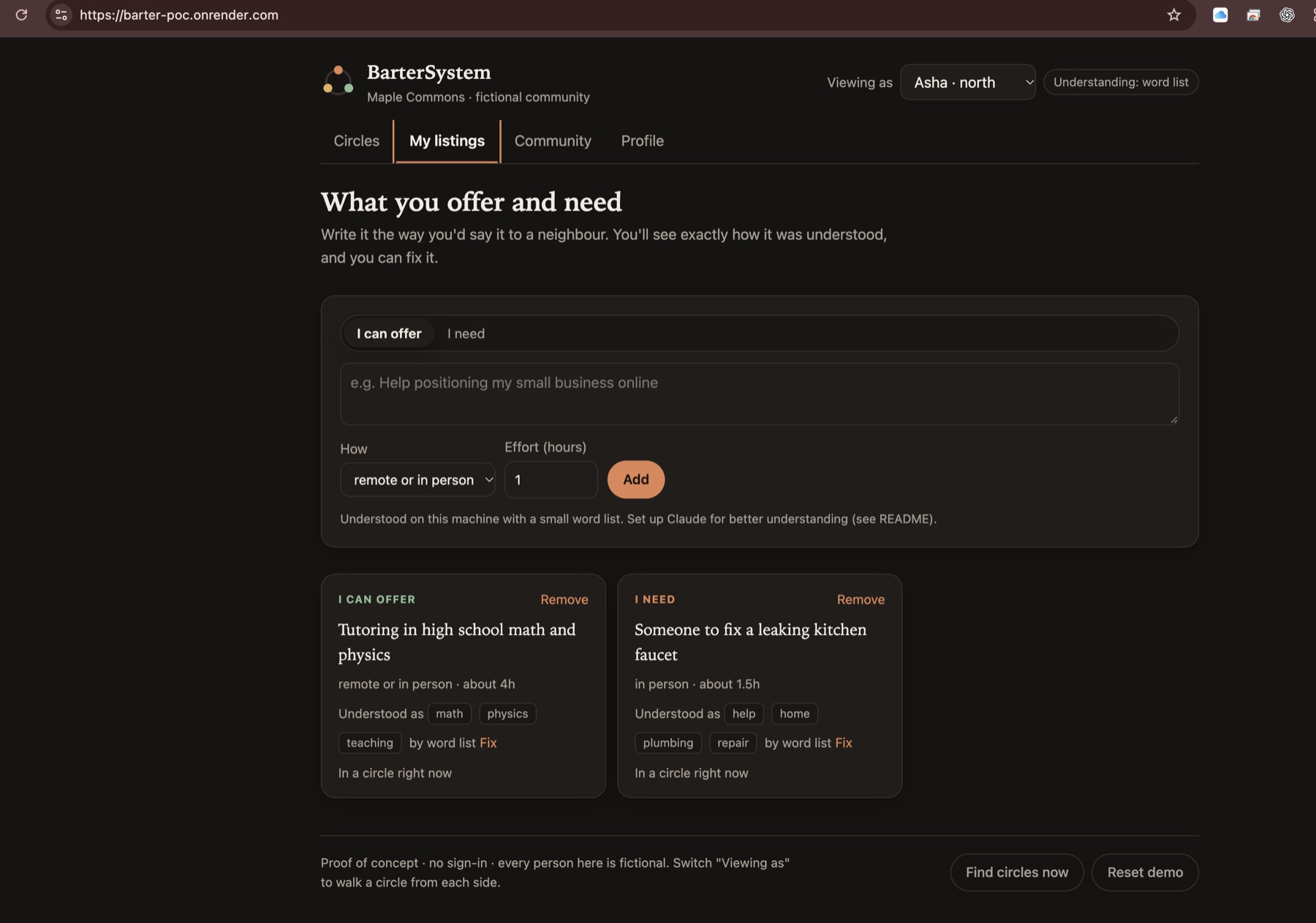
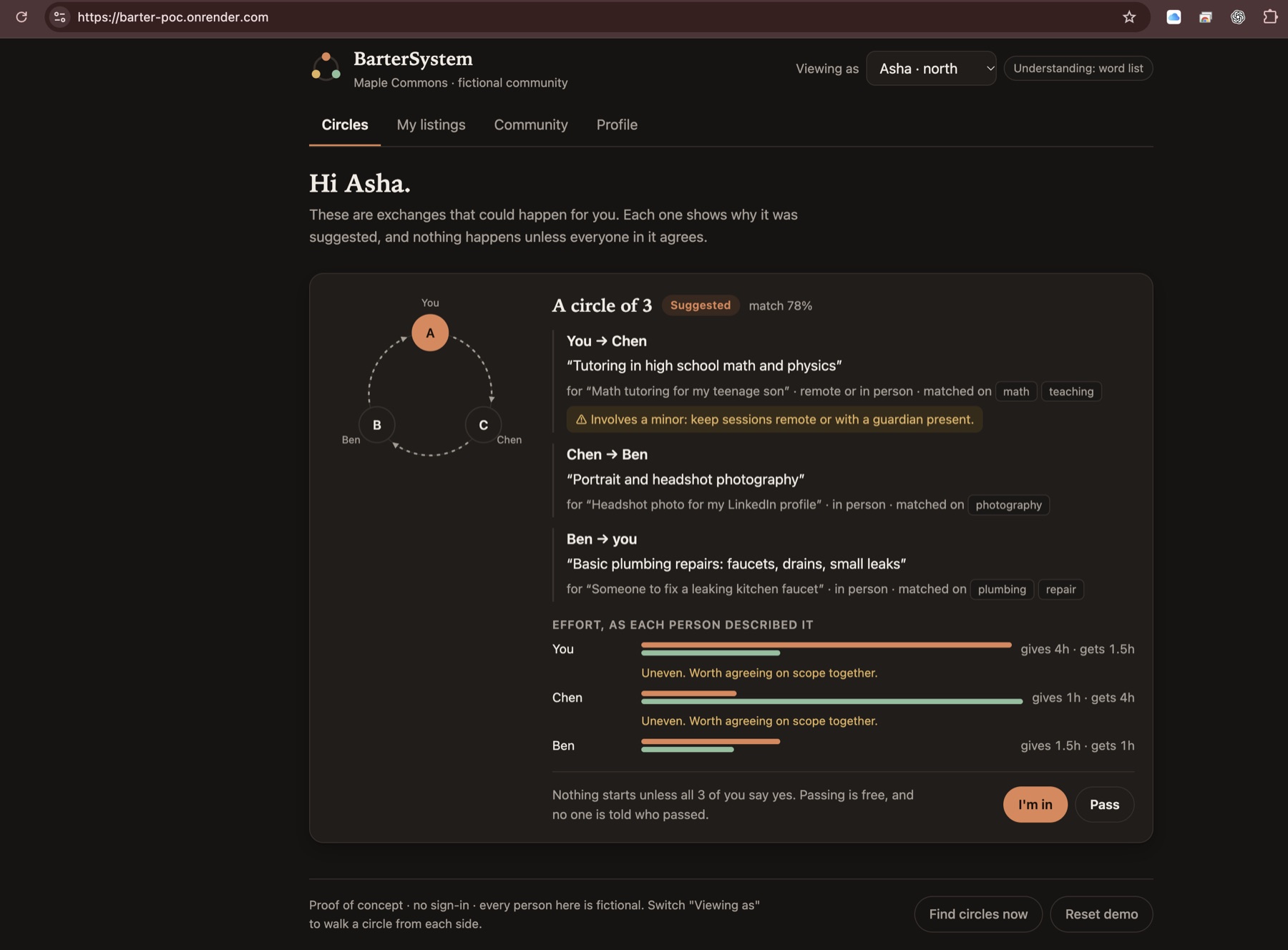
The POC uses a fictional community called Maple Commons. Asha offers high-school math/physics tutoring and needs a leaking faucet fixed. Ben offers basic plumbing and needs a LinkedIn headshot. Chen offers portrait/headshot photography and needs math tutoring for his teenage son.
Asha tutors Chen’s son. Chen takes Ben’s headshot. Ben fixes Asha’s faucet. Each person gives something they can offer and receives something they need, without money changing hands or any pair needing a direct two-way barter.
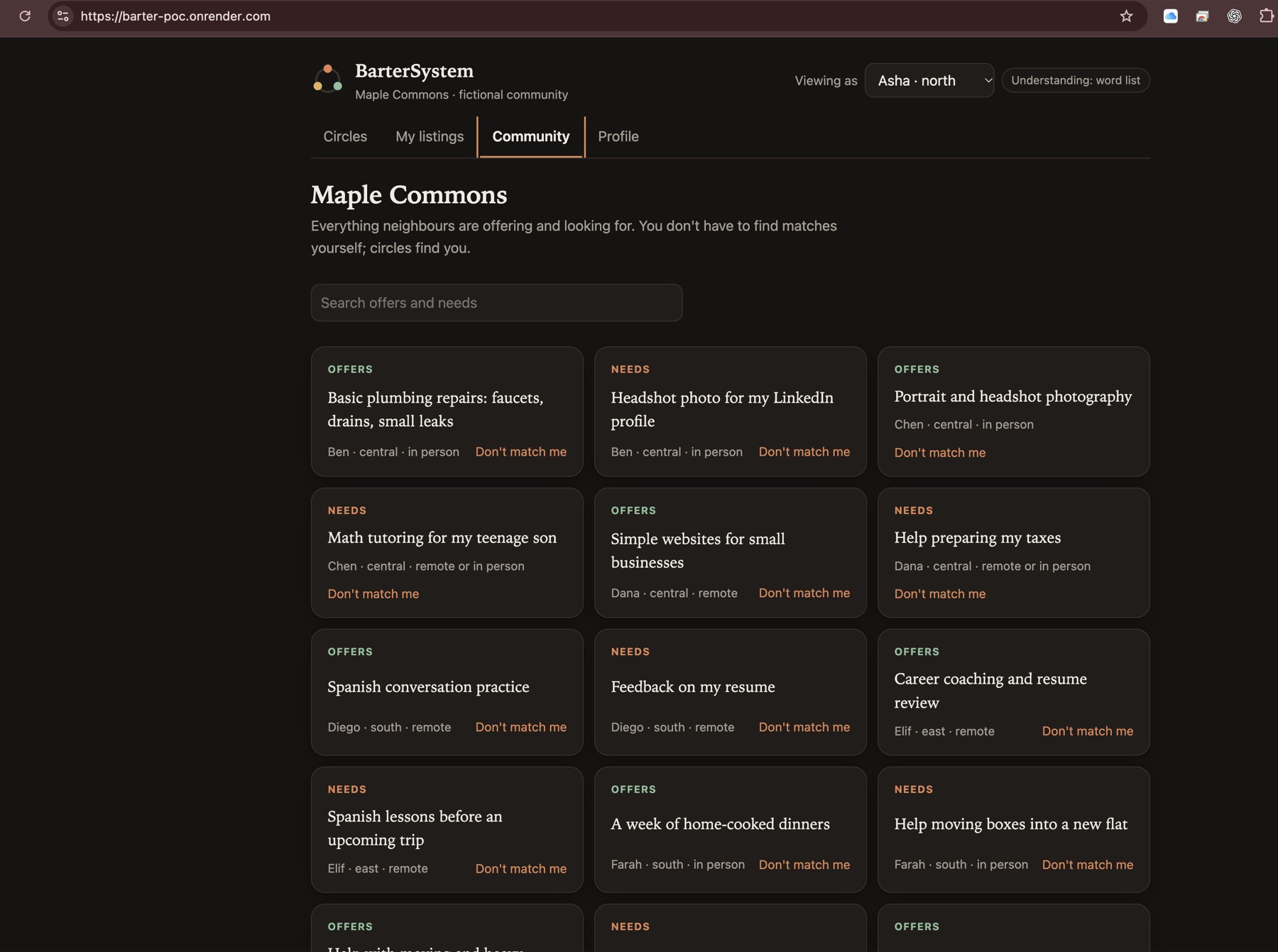
That is the experiment: people describe their offers and needs, and the system searches the network for viable exchange circles. The POC already represents constraints such as region, remote versus in-person participation, and the ability to say “Don’t match me.” A circle has to fit people’s constraints as well as their needs.
A look inside the proof of concept
These screenshots show the fictional Maple Commons community in the current POC. Select an image to view it at a larger size.
What if Barter becomes a capability an agent can call?
Building this also connected with an idea I explored in The Next App Store Might Not Have Apps: a useful service could become a capability an agent calls. Someone might tell their AI agent:
“I need someone to fix my faucet, but I'd rather trade something than pay cash.”
With permission, the agent could help that person formulate what they are willing to offer. Maybe it is software help, tutoring or something else they had not thought to list. It could submit their needs, capabilities and constraints to Barter, retrieve viable circles, explain the proposed exchange, and ask the humans involved to approve before anyone commits.
The agent would help express intent and carry context. Barter would do the specialized work of finding a match across the network. Human agreement would still be essential.
That is the direction I want to explore: Barter as an agent-callable clearing and matching capability. A website can make offers and circles visible, while an API could let different agents bring people’s needs into the same network. The value would come from discovering a workable exchange across participants, rather than requiring everyone to browse another marketplace UI.
This is still an early proof of concept with a fictional community, not a production service. The agent/API flow above is a possibility I want to test, not a claim that those integrations exist today. Real exchanges would raise further questions about trust, fairness, scheduling and what happens when someone cannot follow through.
For now, I have something concrete to learn from. Seven years after that two-line note, I have a small matching network to experiment with—and a new question about which parts of it need to be a website at all.
Explore or contribute: BarterSystem on GitHub · Contribution guide · Open starter issues
Sources & further reading: IMF: Generative AI and the Future of Work · Federal Reserve Bank of St. Louis: Money versus barter · IRS: Bartering income